Dance and Drama
The lifestyles of Balinese people is expressed in their dance. Not only do we learn about the Balinese religion from their dance creations but also we can come to understand the flow of cultural events and activities that belong to everyday life. We can discover Balinese attitudes, how they look at nature, and how they regard their fauna and flora.
The very essence of the Balinese culture is dance and drama, which is performed during temple festivals and in ceremonies. The dances performed in hotels is a small fraction of what Balinese dance has to offer. Balinese dance goes as far back as Balinese written history with much of the heritage originating from Java. Ironically, as a result of the Islamisation of Java, the Javanese culture has disappeared but has still survived in Bali and has become part of classical Balinese culture.
Balinese dance cannot be separated from religion. Even the dances for the tourists are preceded by many dancers praying at their family shrine for taksu (inspiration) from the gods.
Dance fulfils a number of specific functions: It may be a channel for visiting gods or demons, the dancers acting as a sort of living repository. It may be as a welcome for visiting gods. It may be entertainment for visiting gods.
The typical posture of Balinese dance has the legs half-bent, the torso shifted to one side with the elbow raised and lowered in a gesture that displays suppleness of the hands and fingers. The torso is shifted in symmetry with the arms. If the arms are to the right, the shifting is to the left and vice-versa.
The Ramayana
The story of the Ramayana greatly inspires the Balinese. Many of their dances are based on this great story which is often depicted in a ballet. The Balinese version differs from the Indian Version. It is told that Rama, as the first son in a family, was the heir to the Ayodya kingdom but the king's second wife, through her treachery forced the king to crown her own son as the King of Ayodya and asked him to send Rama and his wife into exile.
Because he respected his father, Rama went with his wife called Sita and his beloved younger brother, Laksmana into a forest called Dandaka. Usually the first act of the ballet depicts Rama and entourage in the heart of the Dandaka forest.
Rahwana, the evil King of Alengka, enchanted by the beauty of Sita, wanted to have her as his concubine. He sent one of his knights, Marica, to temp Sita by transforming himself into a golden deer. Sita, captivated by her curiosity, asked her husband to catch the golden deer.
The next act explains how Rama succeeds in hunting the golden deer but as his arrow struck the golden deer it transformed back into Marica. Meanwhile Sita heard a distant cry for help. Laksmana, who had been asked by his brother to look after his sister-in-law, tried to explain to her that the cry sounds very suspicious. But nevertheless, Sita was convinced that someone was in need of help. So she sent Laksmana to look for this person and to help whoever it is. In his desperate attempt, Laksmana asked Sita, no matter what would happen, to stay inside the guarding circle that he created.
Rahwana, knowing that Sita was protected by the circle transforms himself into an old priest. He approaches Sita and asks her for a drink. Sita, without hesitation, extends her hands beyond the circle to hand him the water. Rahwana takes the advantage, snatches her hand and takes her to his palace in Alengka.
On the way, Rahwana encounters a mighty eagle Jatayu. By every means possible, Jatayu tries to rescue Sita from the evil king but fails and is killed by Rahwana.
Rama and Laksmana find the dying Jatayu who tells them the whole story of what had happened to Sita.
In his attempt to release his wife, Rama seeks the help from Hanoman and his monkey soldiers. Hanoman finds Sita in the palace's garden. She had been asked by Rahwana to marry him but she would rather die. Hanoman convinces Sita that he is Rama's messenger and talks of a plan.
Rahwana catches Hanoman and burns his tail but in so doing, set fire to the palace's' gardens. The pyrotechnics can be very impressive.
In the last act, Rama and his troops are depicted attacking Rakhwana's palace. Finally Rama manages to kill Rahwana and therefore takes his wife back to his country.
The abridged version ends here but if you see paintings in Kamasan style based on the Ramayana story, you would notice that in the last of serialised paintings, Sita had to prove she was still pure, and had not been tainted by Rahwana, by plunging herself into a fire. Because of her faith in her husband, God saved her from the fire and she lived happily ever after with Rama.
The Indian version reveals a very different ending with Sita saved by Mother Earth, never returning to her husband.
The Welcome Dance - Tari Panyembrama
The Panyembrama is probably the most popular Balinese social dance. In keeping with its meaning in the Balinese Language, Panymebrama is frequently staged to welcome guests of honour who are making a visit to this islands of the Gods. Four or eight young girls bearing a bokor, a heavily engraved bowl made from silver or aluminium, laden with flowers, dance expressively to the accompaniment of vibrant gamelan music.
During the dance, the flowers are scattered over the guest or audience as an expression of welcome. The Panymebrama has taken many of its movements from temple dances, such as the Rejang Dance, Pendet and Gabor, which are considered sacred and performed exclusively for God. There is an analogy between the secular Panymebrama and the religious temple dances, as all these dances are welcoming dances, the difference being in the place in which they are stage.
The Tari Panymebrama comes under the Balinese classification of Legong (individual dances), because it has no connection with other dances, has no story and was specifically created for welcoming and entertainment purposes.
The hospitality and friendliness conveyed through the smiles of the Panymebrama girls, charms the audience and so is very fitting as an opening for a show, etc.
The Yudapati Dance
Yudapati is a dance which depicts a male character but is performed by female dancers. The word Yudapati is derived from Yuda which means war and Pati which means death. The dance represents the kamikaze warrior in defending the truth. The dance was created in 1987. It is based on the Baris dance. The dancer wears typical male attire, headcloth, shirt, carved leather belt and other jewellery. The reason for a male being performed by a female is that the choreographer wishes to reveal all the subtle gestures and movements in the dance by using the flexibility of a woman's body.
Male dance performed by females is called Bebancihan. A number of other dances have been created in the s style, such as Margapati, Trunajaya, Prawireng Puti, Wiranata and Danur Dara. They require masculine interpretation and expression which is quite hard for female dancers. Yudapati dance was originally performed for religious purposes but nowadays is performed regularly as a tourist attraction in some restaurants.
The Ghopala Dance
This dance provides the audience with an interesting insight into the lives of people who live in a simple and pure manner in an environment of blissful tranquillity. This dance originated in 1984 and usually performed by five boy dancers. The characters of the Ghopala dance are especially funny and will draw laughter from the audience.
The Ghopala theme depicts the world of children herdsmen who gleefully meet and play along the boundaries of rice fields while tending their cows. Their lives are filled with happiness as they dance and play in a way which highlights their individual characters. They never tire of their duties as herdsmen, faithfully defending the lives of their cattle. Thus the audience are transported to a distant time when people lived in peace and contentment, an age which had not yet become influenced by the bustle of business which now constantly steals our time.
The Semarayana Dance
As we know, there exists many art forms such as music, painting, poetry, drama, sculpture, etc. and, of course, dancing is yet another and is a popular form of expression. Artists will take a certain aspect of a medium, build on it to form another. This is the case of the Semarayana dance developed in 1994 as a subject for a thesis submitted by Ms Ni Nyoman Sri Armita to the Indonesian Arts Academy of Denpasar for her graduation.
The main character is Dewi Chandra Kirana, a princess from the kingdom of Daha who disguised herself as a male youth so she could venture out and seek her beloved who had disappeared without a trace.
With shoulder length hair, commonly used centuries ago throughout Java and Bali, the princess was unrecognisable as a female. The symbol of manhood which fooled people she met on the road, was the use of the Balinese male headgear called the Destar. It is made from material that wraps around the head and has an artistic formation of bunched material at the front.
Balinese males still use the destar when attending ceremonies. The feature of the destar is the decorative use of gold lines.
Dewi meets her beloved but due to her disguise and the fact that he is partly obscured when they meet, a fight develops. In the ensuing melee, the princess's destar is knocked from her head and her sweetheart, Raden Inu Kertapati, recognises her and rushes to her side to embrace her.
And, of course, they lived happily ever after.
The Barong Dance
The are several versions of the Barong Dance, as Bali has an abundance of myths and legends. There is Barong Ket, Barong Asu (Dog Barong), Barong Macan (Tiger Barong), Barong Bangkal (Pig Barong), Barong Gajah (Elephant Barong) and others.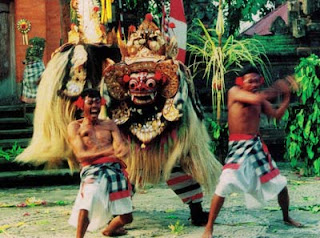 One of the well known stories on which the Barong Dance is based, is the Kunti Seraya. The plot is very intriguing, showing the effect of the Gods intervention upon the people through supernatural powers.
It is told that Dewi Kunti, from the royal family of Hastinapura, was very ill. As a devotee of the Goddess Durga, she seeks help, however, the Goddess tells her that the price of health is her own son, Sahadewa. It seems that the Goddess fancied Sahadewa's young and luscious flesh for her dinner.
Dewi Kunta recovers from her illness and it is time to pay the price. She regrets her decision to pay the price but a promise is a promise. One of the Goddess's followers put her into a trance and enters her body. She becomes a terrifying creature and unconsciously beats Sahadewa mercilessly. She then takes him to an unpenetratable jungle and ties him to a tree. Later Sahadewa is given immortality by God and she overcomes the wrath of the Goddess and she is able to release her son.
The Sanghyang Jaran Dance
The unique feature of the Sanghyang Jaran dance is the courage of the dancers who in a state of Kesurupan or trance, calmly step and trample on red hot coals just as if they were walking in cold water.
This dance is believed to have the power to invite the gods or sacred spirits to enter the body of the dancers and put them in a state of trance. It dates back to the ancient Pre-Hindu culture, a time when the Balinese people strongly believed that a dance could eliminate sickness and disease. The is dance is usually performed in the fifth or sixth month of the Balinese traditional calendar as it is believe that during these particular months, the Balinese are vulnerable to all kinds of illnesses.
The War Dance - Gebug Ende
The Gebug Ende is a combination of dance and trial of prowess. It is usually performed by two to sixty male dancers who dance and fight on stage in pairs. Each dancer/fighter carries a one and a half metre long rattan stick as as a weapon and a shield called an ende. During the performance the two men try to beat one another with the stick while using the ende to protect themselves. The dance is called Gebug Ende as it literally means beating the ende or shield. One cannot afford to make mistakes in this dance as otherwise injury results.
The Gebug Ende is quite unique as it has certain rules that have to be followed by the participants. Led by a jury, this dance starts with two dancers, while the rest sit in a circle, cracking jokes and singing, while waiting their turn. The jury decide which of the two contestants loses the game and has to leave the stage. Then they will call the next men to the stage. This continues until all have had a turn. Sometimes the fight becomes very fierce and the dancers get thrown of the stage from the blows of the rattan stick. Bruises and wounds are common in this ritual.
Legong Trunajaya - The dance of love and emotions
The Trunajaya dance describes the emotions of a young man through love and passion. The dance movements reflect the theme of courtship and love.
Truna meaning 'single' and jaya meaning 'to win' immediately gives an understanding of the dance. Ironically, the dancer are young women who take on the role of young men. The women wear a 'destar' normally worn by men and an unusual loin-cloth called a 'kancut'. The Trunajaya is normally danced by a single female but sometimes two, dancing together in synchronous movements and to the mesmorotic sounds of the 'Gong Kebyar', a fast, rhythmic beat which goes in harmony to the dance. The dance was created by Wayan Wandres, from Singaraja, Northern Bali.
The Balinese, anthropologists suggest, are an amalgamation of a number of people. The Chinese coming from the North, the Indian and the Arabs from way West, and other groups coming directly to Bali or by way of Java. Centuries past, and they become what is now known as native Balinese. They are blessed with well-developed bodies, golden-bronze skin, long, glossy black hair, and charm and mystical smiles, happily living in a rich and complete yet dynamic culture.
There are pockets of villages in which fraternization with outsiders is completely restricted, resulting in a people and a culture that the Balinese called Bali Aga (Old Bali), which may curiously be the tunnel that allows us to periscope into the culture of Bali in the past centuries.
People, Religion, and Temples
You can observe this even in little children. As their parents go to plant rice, the children - all seem to be in their best behavior - play with their age group. The older ones will care for the younger ones. Fights rarely occur, and loud screams or cries are even scarcer. As if they have been taught to be at harmony with their surroundings.
The Balinese also has a built in population control mechanism through their naming structure. In Bali, all first child is named Wayan, second child is Made, the third child is Nyoman, and the fourth, or the last, is Ketut. If you have more than four? Well, the Balinese seem to have understood modulo arithmetic, so it's back to Wayan, Made, Nyoman, and Ketut, repeat. But implicitly, the culture discourages having more than four children.
Though originating from India, the brand of Hinduism known and practiced in Bali differs significantly from the one found in India. Instead of mysticism or philosophy, the emphasis of Bali's Hinduism is more in rituals and dramatic features, allowing the religion and its practice to be incorporated into daily life of Balinese peasants. These rituals and dramatic features have been intricately woven into the lives of Balinese to the extent that one cannot separate the religious life of Bali from its daily life. In fact, one can say every little action of a Balinese has some religious connotation; stone and wood carvings, cremation ceremony, trance dances, vibrant music - all are intended to please the gods and the goddesses. These rituals most often take place in a temple, the most important structure in the Balinese culture.
Food

The culture of Bali is unique. People say that the Balinese people have reached self-content. It is not an exaggeration that when a Balinese is asked what heaven is like, he would say, just like Bali, without the worries of mundane life. They want to live in Bali, to be cremated in Bali when they die, and to reincarnate in Bali.
It does not mean that the Balinese resist changes. Instead, they adapt them to their own system. This goes back far in history. Prior to the arrival of Hinduism in Bali and in other parts of Indonesia, people practised animism. When Hinduism arrives, the practice of Hinduism is adapted to local practices. The brand of Hinduism practised in Bali is much different from that in India. Other aspects of life flow this way.
Traditional paintings, faithfully depicting religious and mythological symbolisms, met with Western and modern paintings, giving birth to contemporary paintings, free in its creative topics yet strongly and distinctively Balinese. Its dance, its music, and its wayang theaters , while have been continually enriched by contemporary and external artistry, are still laden with religious connotations, performed mostly to appease and to please the gods and the goddesses. Wood and stone carvings, gold and silver crafts parallel the development of paintings, gracefully evolving with external forces to enhance their characters. The batik of Bali owes its origin to Java, and inspired the development of ikat and double ikat.
 Alam Kulkul Boutique Resort 4 star / 80 rooms
Rates: Alam US$ 80.00 / Lanai US$ 100.00
Long a favorite for bringing the Balinese way of life into an intimate and charming setting, the Alam Kul Kul continues to set the pace with today's discerning travelers. Contemporary Balinese design together with professional and courteous service and a unbeatable location just a step or two from Kuta Beach make the Alam KulKul a fine choice and one of Bali's most popular value for money hotels.
 Barong Hotel Kuta 2 star / 98 rooms
Rates: Standard US$ 33.00 (include breakfast)
Tucked away on Jalan Segara Batu Bolong in the midst of Bali's famous Kuta Beach, The Barong Hotel Bali, one of Kuta's favourite hotels, offers good, clean accommodation for today's value conscious traveler.
 Bounty Hotel Kuta 3 star / 166 rooms
The Bounty Hotel, situated in the heart of Kuta, is one of Bali's most popular hotels. Ideally located on Jl. Poppies II between the beach and all of Kuta's best night spots, the Bounty Hotel Kuta Bali puts guests in the centre of Kuta's shops, restaurants and nightlife. Clean, spacious rooms and friendly staff at very reasonable rates all add up to good value for money.
 Champlung Mas Hotel 2 star / 70 rooms
Rates: Standard US$ 32.00 / Superior US$ 40.00 (include breakfast)
Located in the very heart of Kuta a quick 20 minutes drive from the airport and surrounded by shops, restaurants and nightspots the Champlung Mas Hotel Bali offers 70 clean, comfortable and spacious guestrooms at down to earth rates. With good value for money just a few metres from Legian's attractive white sand beach and popular surfing spots the popular Champlung Mas is a good choice for a fun filled holiday.
 Dewi Sri Cottage Kuta 2 star / 58 rooms
Rates: Standard US$ 33.00 (include breakfast)
Situated at the end of Gg. Troposone, just off Jl. Legian (about 500 metres) the Dewi Sri hotel is the perfect blend of being in the middle of Kuta's nightlife yet still tucked away at the end of a quiet alley. A sister hotel of the ever popular Barong Hotel - you'll find the same great money for value services and facilities.
 Hard Rock Hotel Bali 5 star / 418 rooms
Rates: Superior US$ 151.25 / Deluxe US$ 169.40 (include breakfast)
Asia's first Hard Rock Hotel, the Hard Rock Hotel Bali continues to set the pace for beach resorts everywhere. Strategically located just across from Kuta's prime surf beach and surrounded by shops and restaurants the Hard Rock Hotel Bali presents a delightful twist to fun in the sun with its unique all in one rock 'n roll resort concept.
 Harris Riverview Kuta 4 star / 135 rooms
 The Harris Riverview Hotel Bali features of 100 one bedroom guest rooms and 52 one and two bedroom residences specially designed for family holidays and long staying guests looking for a central location nearby to Kuta and Legian areas and just around the corner from Jl. ByPass for quick and easy access around Bali.
 Hotel And Spa Maxi Kuta 3 star / 50 rooms
 Rates: Standard US$ 35.00 / Deluxe US$ 45.00 (include breakfast)
Hotel And Spa Maxi Kuta central location along Jl. Legain puts guests right in the heart of all the best that Kuta has to offer. Paddy's Pub II and the Apache Bar, two of Kuta's most popular nightclubs, are directly across the street and the hotel is surrounded by any number of good restaurants and fine shops. With its spacious and clean rooms, Hotel And Spa Maxi Kuta Bali is a good choice for those looking to enjoy Kuta's exciting nightlife.
 Ida Hotel Bali 1 star / 57 rooms
Rates: Standard US$ 33.00 / Standard Bungalow US$ 33.00 (include breakfast)
A tranquil oasis in the midst of bustling Kuta, Ida Hotel is set in a lovely tropical garden. Just a quick stroll to Kuta's white sand beach and surrounded by great shopping, dining and night spots, the Ida Hotel Kuta Bali puts visitors in the centre of Kuta with good, clean rooms at good value for money rates that is well suited for the budget conscious traveler.
 Inna Kuta Beach Hotel 4 star / 129 rooms
Rates: Deluxe US$ 80.00 / Cottage US$ 90.00 (include breakfast)
Formerly the Natour Kuta Beach, with its premier beachfront location in the heart of Bali's famous resort area the Inna Kuta Beach Hotel Bali couldn't be better located. Located just across the street from the Hard Rock Beach Club Hotel & Hard Rock Cafe and just steps from Kuta Square shopping area and the Inna Kuta Beach Hotel Bali offers good accommodation with traditional Balinese flair.
 Kuta Beach Club Hotel Bali 3 star / 100 rooms
Rates: Standard US$ 47.00 / Bungalow US$ 62.00 (include breakfast)
Situated in the heart of Kuta's bustling restaurant, entertainment and shopping district and just a short stroll from Kuta Beach, the Art Market, Water Bom Park and Hard Rock Cafe the Kuta Beach Club Hotel Bali is in the ideal location to explore Kuta and offers good value for money for visitors looking to stretch their travel budget.
 Kuta Lagoon Resort 3 star / 82 rooms
Rates: Standard US$ 50.00 / Deluxe US$ 62.00 (include breakfast)
Situated in the heart of Kuta, at the end of a narrow lane that takes you away from the hustle and bustle of Kuta, the Kuta Lagoon Resort (formerly the Kuta Legian Village) is a small oasis of tropical tranquility where simple yet clean and comfortable hotel accommodation at a very affordable rate awaits.
 Kuta Seaview Cottage 4 star / 82 rooms
Rates: Superior US$ 80.00 / Deluxe Garden US$ 94.00 (include breakfast)
Situated directly across from Kuta Beach with a backdrop of pounding surf and magnificent sunsets, the Kuta Seaview is conviently located between Jl. Poppies I & II making access around Kuta fast and easy. Guest rooms are comfortable, clean and well appointed.
 Mercure Kuta Bali 4 star / 130 rooms
Set directly across from world famous Kuta Beach and smack in the centre of the Bali exciting beach scene, the Mercure Kuta Bali hotel's contemporary design takes full advantage of the stunning ocean views and memorable sunsets. Incorporating the best of traditional Bali with a modern flair the Mercure Kuta Bali puts you on Kuta Beach in style and comfort at a very competitive rate.
 Ramayana Resort & Spa 4 star / 217 rooms
Rates: Deluxe US$ 115.00 / Executive Dlx. US$ 135.00 (include breakfast)
It's hard to say enough about the Ramayana Hotel. One of Kuta's all time favourite hotels, Ramayana just keeps getting better with time. Location couldn't be better, smack in the heart of Kuta just steps from the beach and near the family attractions in Tuban the hotel offers excellent 4 star facilities at very reasonable rates. All in all, good value for money.
 The Oasis Hotel Kuta 3 star / 70 rooms
Rates: Standard US$ 45.00 (include breakfast)
Located in the heart of Kuta just off Jl. Bakung Sari The Oasis Kuta is nicely positioned to get the most out of a your Kuta holiday. Just down the street and within easy walking distance to Kuta Square shopping centre, Kuta beach, the Hard Rock Cafe etc., The Oasis Hotel Kuta is a good choice for budget conscious travelers looking for a contemporary style hotel in a quiet setting at reasonable price.
 Villa de daun 4 star / 12 rooms
 Rates: 1-Bdrm Pool Villa US$ 220.00 / 1-Bdrm Deluxe Pool Villa US$ 286.00 (include breakfast)
Stunningly beautiful, Villa de daun is without doubt the most beautiful and luxurious hotel in the heart of Kuta. Tucked away down a peaceful Gang (lane) just off bustling Jalan Legian, the area surrounding Villa de daun is dotted with fine restaurants serving a wide variety of international cuisines, great shopping and exciting nightspots - putting guests within easy walking distance to one of the most vibrant neighbourhoods on Bali in style.
 Villa Diana Kuta star / 16 rooms
 Rates: Standard Room US$ 48.00 / Deluxe Room US$ 49.00 (include breakfast)
Well situated in the middle of Legian, Hotel Villa Diana Bali offers just 16 guest rooms and suites in a contemporary, modern setting at attractive rates. Close enough to enjoy all the best shopping, restaurants and night spots of Legian and Seminyak yet just far enough away to offer a quiet haven for those both seeking to unwind in a relaxed atmosphere.
Preferred Melati Hotels in Kuta Bali
Bali Sorgawi Hotel 3 melati / 26 rooms
Rates: Standard Room IDR 300,000 / Deluxe Room IDR 350,000 (include breakfast)
Even though it is in the heart of Kuta, it takes a bit of looking to find the Bali Sorgawi Hotel with its location at the far end of a private drive off Jl. Legian. But the search is worth it for budget conscious travelers looking for safe and affordable accommodation within walking distance to Kuta's innumerable shops, restaurants and nightclubs. Small and cosy with only 26 rooms, the Bali Sorgawi Hotel is surprisingly full featured. Good value for money is on offer at Bali Sorgawi.
Balisandy Cottages 3 melati / 55 rooms
Rates: Superior IDR 300,000 / Deluxe IDR 325,000 (include breakfast)
Situated at the end of a quiet lane just off popular Poppies Lane II, the Balisandy Cottages is an easy hotel to overlook and that is unfortunate as the Balisandy Cottages offers some of the best value for money accommodation in the centre of Kuta. And being small hotel with only 37 guestrooms, the Balisandy Cottages is able to offer friendly and personalised service larger hotel hotels just can't match. Those looking for a comfortable secure accommodation at extremely attractive rates will be hard pressed to do better than the Balisandy Cottages.
Bamboo Bed & Breakfast 2 melati / 7 rooms
Rates: Twin - Share US$ 27.00 / Twin - Private US$ 31.00 (include breakfast)
Situated along Jalan Legian in the heart of Kuta/Legain shopping and entertainment district is the Bamboo Legian. With its distinct and modern design, the Bamboo Legian offers true european style bed and breakfast accommodation at very attractive rates for today's dynamic international traveler. Small and personal with only seven rooms available, the Bamboo Legian is a cosy alternative for those looking for simple accommodation in a stylish setting.
Restu Bali Hotel 3 melati / 40 rooms
Rates: Standard US$ 34.00 / Superior US$ 41.00 (include breakfast)
With it's unbeatable location along Jl. Raya Kuta, smack in the heart of Kuta - the Restu Bali Hotel is within walking distance to just about everywhere. The area's best shops, restaurants and nightclubs are just steps from the lobby. Even so, the hotel is set back off the street, a quiet oasis with rooms that are clean and comfortable. And the service is warm and friendly; treating each guest like family makes the Restu Bali Hotel one of Kuta's most popular hotels for budget sensitive travelers.
Simpang Inn Kuta Bali 3 melati / 60 rooms
Rates to be advised
Surrounded by shops, restaurants and nightclubs and just a minutes from Kuta Beach the Simpang Inn is within easy walking distance to all the fun in Kuta. A small family owned hotel known for its friendly service and clean accommodation, Simpang Inn puts guests in the heart of Kuta at reasonable down to earth rates.
Yulia Beach Inn Kuta 2 melati / 34 rooms
Rates: Standard US$ 40.00 / Bungalow US$ 45.00 (include breakfast)
Welcoming guests since 1972, the Yulia Beach Inn has a well deserved reputation as one of Bali's premier value for money hotels. Ideally located in the heart of Kuta just down the street from Kuta beach the hotel is smack in the heart of all Kuta's attractions and entertainment options, shops and restaurants. As a family run hotel you can be assured of friendly Balinese service and secure, very clean and well maintained rooms at very attractive rates.
 It was friendly weather for all involved at Volcom Stone’s Grillfish Surf Series, held last Sunday April 12th, with just a few clouds forming a nice barrier between spectators and the blasting Bukit sun. The waves couldn’t have been more perfect either, 2-3 feet high with a constant stream of spot on barrels.
The most interesting to watch in the Under 14’s category was little Tommy Sabri, who led from the first heat with his snap and floater maneuvers. Too bad he didn’t get any waves in the finals, leaving I Kadek Koko Mitsua Antara as the winner.
From early on it was a tight competition between Agus Sumerta Yasa and Agus Sudiantara for the Under 17’s finals. But Agus Sumerta Yasa kept up a strong ability to control the waves, and won the final heat with a significant point difference thanks to his smooth cutback and snap maneuvers.
It was also intense at the Pro-Am division. I Kadek Arya Wiarta actually led the score board and was about to snag the first place, but within the last minutes Mega Semadhi dropped a seriously big air and landed perfectly clean. This earned him high points and took him to victory.
The prize presentation was held after the contestants enjoyed their free lunch and Volcom’s signature giveaway frenzy marked the end of the day.

Pirates Cruise Party
Bringing a new party innovation to the shores of Bali, or perhaps just off the shores of Bali, Marlboro Black Menthol got seaside and turned a cruise ship into a pirate’s party haven. With a 10pm kick off in the Bounty Cruise Quay lobby, stillt walkers welcomed the eager crew, DJ’s Mita Keyla and Dita Zizta spun tracks as Resty and Jeje Ramona MC’d and a fashion show got everbody warmed up for the night. Around midnight and it was time to hit the wooden deck while DJ Beta Costa hit the vinyl decks. C&C models set another fashion parade in motion and as the ship continued to set sail, DJ Soma kept the sonic waves afloat ‘til 3am. She’s a fine mistress yee ocean!
 Mr Caseli has become quite the name around town, drawing plenty of eager ears out to Blue Eyes a few weeks back and again bringing the crowd to Hu’u in a big way in the last fortnight. It’s always good to see a DJ as excited to be there as everyone else and Matt didn’t hold back with the ‘wave your hands in the air like you just don’t care’ action. After a long standing residency at Ibiza hitting almost 12 years, you could say there’s a little experience under this guy’s collar and it was keeping everyone on a high. The sound system seemed to be feeling the pressure which may have been slightly distracting for those with keen ears, but the room remained packed and the crowd pushed right out to the back bar. Hu’u definitely wins on use of space, drapes breaking up a huge outdoor area to create intimate pockets to chill out in, soft lighting and huge pillows perfect for a post dance lie down. Another lychee martini thanks...

With the Indonesian Surf Championships kicking off at the end of April, we hit the beach to see where the surfing spirit is at...
Introducing...
MATTIA: Hello, I am Mattia, Italian surfer, born in Milan 9 November 1990.
How long have you been living in Bali?
M: I have been living in Bali for the past 8 years, it doesn’t seem like that long because it’s such a great place.
Can you speak Bahasa Indonesian?
M: Bisa! harus bisa! (I can! I must be able to!)
What is your surfing background?
M: well, I surf mostly for fun, nothing serious, but I do a couple of contests every now and then, it helps to keep my sponsors happy.
What got you into surfing?
M: Well, the first time I came to Bali was in the year 2000, I saw people surfing in Legian and I said to myself “I wanna do that one day”. The next day I rented myself a body-board and I was trying to stand up on it, because I was so little I could! After a few days i got a surfing instructor from Legian and they taught me well.
How did you feel when you got your first wave?
M: well I didnt really get to stand up on my first wave but i felt great.
What are the benefits of surfing?
M: Well there are many benefits if you are a surfer; chicks love surfers, you get this amazing feeling when you’re riding waves, your body gets fitter and healthier and once you start you can’t stop, i dont know if that’s a benefit though!
What is your favorite moment when surfing?
M: My favorite moment when i surf is when i score good waves and ride great barrels with no one around.
What kind of surfing do you like the best?
M: I love free surfing; going on trips just for fun is the best for me.
Have you ever been close to drowning or injured?
M: No luckily I haven’t drowned yet! But yeah I got injured once before, last time I was at the mentawais for an 8 day trip, I cut my back up pretty bad.
What is your favorite beach?
MATTIA: Well I like surfing everywhere but my favorite beaches are Bingin and Canggu.
What surfboard do you use?
MATTIA: I mainly use short-boards because I can do airs and stuff, cant do those on a long-board can you?
Any unforgettable moments?
MATTIA: I’ll never forget the 18th of July 2008, best Padang-Padang EVER!
Tell us about the contests you’ve been involved in...
MATTIA: Well I do the ISC tour (Indonesian surfing championship) and I hope this year I get to go into the top 10, its been really hard because now that I’m not a grommet anymore I have to compete with the opens which is really hard to win. But hopefully this year I can do better.
If you’ve signed up for the ISC the waiting period begins on the 26th of April so when the good waves hit you better be ready for that call...

Think of a tropical island and the image that springs to mind is that of a sandy beach bordered with coconut palms. Beyond a place to indulge in shade though, these symbols of the holiday spirit also provide an abundant source of materials and ingredients that are used for a variety of every day reasons. From root to leaf tip the coconut palm can be used for our benefit, thus earning it the nickname ‘Tree of Life’. Here are a few examples to look out for…
 1.Coconut Water
Breaking open a coconut and drinking down the sweet liquid to be found inside has been the savior for many a marooned man dying of thirst. There are plenty of bars and cafés in Bali that make it a lot easier though. From alcoholic cocktails to simply cutting off the top and adding ice with a straw, coconuts provide a cool remedy to the tropical heat with their natural source of flavored water. Young coconut water is also used for the treatment of high blood pressure and it’s full of amino acids and vitamins.

2.Coconut Meat
Coconut meat is a popular food ingredient, especially in Bali. Head on down to a traditional restaurant and check out the menu for meals such as Yongko, Pisang Rai, Serombotan, Laklak and Lawar; just a few local cook ups that take advantage of the ‘other white meat’. Either that or crack one open on the beach and eat it raw. Now that’s livin’ in the tropics.

3.Coconut Milk
This smooth, creamy white cooking base is derived from the meat of mature coconuts. Its rich taste and color is attributed to the high content of oil and sugars and it comes in two grades; thick and thin. Directly squeezing grated coconut meat through cheesecloth produces thick milk, and repeating this process a second or third time after soaking the used meat in warm water will produce thin milk. Rich, dry sauces and desserts are often cooked with thick coconut milk while soups and general cooking uses thin milk.

4. Coconut Oil
This simple extract produced from pressing coconut meat just happens to be a super health benefit for the body, helping to protect against heart disease, prevent cancer and osteoporosis, empower the immune system, prevent infection, keep diabetes under control and soften the skin when used externally. Also great as a massage oil! Two table-spoons in the morning and at night are enough to start cleansing the system.

5.Coconut Shell
Not even the outside shell of the coconut goes to waste. Balinese cooking often uses a small coal fire to grill fish, corn or beef and the coconut shell is perfect for using as charcoal. It is also used for creating souvenirs and household goods such as rice ladles and ashtrays.

6. Coconut Leaf
The Leaf of the coconut palm has a huge range of practical uses, especially within Balinese Hindu ceremonies to create ornaments and wrap food for serving and cooking. Canang is the ornament placed in various locations as a prayer offering and it is made from cutting and weaving the leaf into a square bowl. Other examples are baskets, handicrafts, roofing and decorations.

7.Coconut trunk
The trunk of the coconut tree is itself commonly used as a building material within housing and bridges, while also being utilized for ornamental carvings, furniture and souvenirs.
Whilst is quite easy to eat very nicely (and cheaply) in Bali, most of that is due to the intense competition of too many restaurants serving too much the same menu. With not much menu differentiation restaurants in Bali have, until recently, competed solely on price. Good for the hungry yobos but where to go for a nice evening and get good value for the money? (btw, good value does not always mean cheap...
Location : Kuta
Cafe Dulang: Indonesian $$
Comments: Super 'soto ayam' (Indonesian chicken soup) that's almost a meal by itself.
Location: Kuta Square Shopping Centre. 2 shops from Matahari & same side of the street.
Kopi Pot: Mixed menu, Indonesian & Western $$$
Comments: Still, after all the years, one of our favorites. A welcome respite in Kuta.
Location: Jl. Legian, Kuta. Parking Telp. 752 614
Kori: Western $$$1/2
Comments: You won't believe that you're still in Kuta, quiet and serene with a nicely prepared menu.
Location: Jl. Poppies II (Near Tubes)
Made's Warung: Mixed menu, Indonesian & Western $$$
Comments: There's a reason the place is a legend; good food, great atmosphere.
Location: Jl. Pantai Kuta / Just west of Bemo Corner Telp. 751 923
Pawon Pasundan: Sundanese $$1/2
Comments: Specialising in Sudanese cuisine (West Java), everything at Pawon Pasundan is delicious. Must tries are the "Flying Grouper" and the ice desserts.
Location: Jl. Kediri No.2 (formerly Jl. Kesatria) - right hand side Telp. 755 833
Pica Tapas Bar: $$$
Comments: Authentic Tapas and Churrasqueria. The real deal for Spainish cuisine in Bali.
Location: Kuta Galeria block River Side No.15 Telp. 769 038 - 769 028
Location : Legian/Seminyak
Antique Restaurant & Bar: International $$1/2
Comments: The cuisine is described as Pan-Asian fusion, an innovative combination of taste and flavour. Whatever... food is tasty and surprisingly inexpensive.
Location: Jl. Dhyanapura - Abimanyu Arcade 7 Telp. 730 907
Chat Cafe: International $$
Comments: Contemporary cafe with a nice, but limited menu that covers all the bases at very reasonable prices. As well there's free wifi internet access available from 7.00 am - 11.00 pm. Comfortable place to drop in or stay connected.
Location: Jl. Kunti 18 Seminyak Telp. 732 303
Cafe Moka: Pastries and Western Favourites $$1/2
Comments: A nice spot for brunch. Nice bakery, light meals relaxed atmosphere. We also like the casseroles and take-away items for quick home dinners.
Location: Jl. Raya Seminyak Telp. 731 424
Earth Cafe: Vegetarian $$1/2
Comments: Small cosy retreat with a surprisingly large menu, well prepared and good portions that will satisfy vegetarians and non-vegetarians alike.
Location: Jl. Laksmana Oberoi, Seminyak Telp. 736 614
Kafe Warisan: French Mediterranean $$$$
Comments: The local perennial favorite for fine dining, Kafe Warisan just gets better and better. Excellent value for money-especially for the daily lunch specials. Absolutely delightful. Reservations recommended especially on weekends and holidays.
Location: Jl. Raya Kerobokan No. 38 Telp. 731 175
Kuni's Bali: Japanese $$$
Comments: Modern and comptempory urban design plus an extensive menu with freshest ingredients at very attractive prices equals excellent value for money.
Location: Jl. Lesmana No. 80, Seminyak Telp. 730 501
La Luciola: Italian $$$1/2
Comments: An all time favourite and one of the few restaurants in Bali where you really should make a reservation - and they'll cook your pasta al dente if you ask nicely. Excellent value for money.
Location: Jl. Oberoi Seminyak - on the beach Telp. 730 838
Made's Warung: Indonesian & Western $$1/2
Comments: Same owners as Made's Warung in Kuta. It's rare to find a sequel as good as the original but Made's Warung in Seminyak has pulled it off. And there's parking!
Location: Jl. Raya Seminyak, (right hand side going north, parking available) Telp. 732 130
Mykonos: Greek $$
Comments: The Greek restaurant in Bali, eating at Mykonos is like eating at home. Presentation may be simple but the atmosphere is fun, the food is delicious and the value is unbelievable. Reservations recommended on weekends.
Location: Jl. Laksmana No. 52 Telp. 733 253
Pizza Club: $$1/2
Comments: The best pizza in Bali. Period. And with several locations around Bali they deliver almost anywhere.
Location: Jl. Laksmana 72B, Seminyak. Telp. 730 614 / Citra Bali, Jl. Bypass Ngurah Rai 23 Jimbaran Telp. 703 294
Queen's Tandoor: Indian $$$
Comments: Bali's premier Indian cuisine restaurant. A little more expensive than others but well worth the money.
Location: Jl. Raya Seminyak No.73 (Gallery Seminyak) Telp. 732 770
Rumors Restaurant: Cafe $$
Comments: The value restaurant on 'Eat Street' in Seminyak Rumours offers a full cafe style menu with an accent on Italian cooking at great down to earth prices.
Location: Jl. Laksmana Telp. 738 720
Sarong Restaurant: $$$1/2
Comments: Delightfully elegant interior that invites guests to linger sets the stage an eclectic menu that is as inventive as it is pleasing to the palate. Portions are very, very generous.
Location: Jl. Petitenget No. 19x, Seminyak. Telp. 737 809
SIP Wine Bar: French $$$$
Comments: The menu is (classic) French, the preparation is faultless and the wine well chosen while the atmosphere is elegant and urbane without being pretentious. A truly delightful bistro.
Location: Jl. Raya Seminyak, No. 16A (near Bintang Supermarket) Telp. 730 810
Tekor Bali: Indonesian and Western $$
Comments: With its beach side location, friendly service, great food and down to earth pricing who could ask for more? Always packed, always good.
Location: Double Six Beach, Legian Kaja, Legian Telp. 735 268
The Beach House at Echo Beach: $$$
Comments: Quintessential beach side restaurant. Good food, wide selection, decent prices, friendly staff, live music once in a while and free wifi to boot. Great place to hang out and enjoy the sun and watch the surf.
Location: Jl. Pura Batu Mejan, Canggu Phone (0361) 738471
The Living Room: Continental $$$1/2
Comments: True to it's name, The Living Room's comfortable atmosphere makes you feel right at home. Sharp service and continental favorites with a tropical flair at down to earth prices make the living room a great place to unwind.
Location: Jl. Raya Petitenget, Batu Belig Telp. 735 735
Tommy's Cafe: $$
Comments: The best breakfast spot in Legian. Hearty toasted sandwhiches and large fuit muffins baked to order - yes, muffins baked to order! Hmmm delicious. Great place to wake up and smell the coffee.
Location: Jl. Werkudara No. 520 Telp. 752 836
Trattoria: Italian $$1/2
Comments: A small intimate Italian restaurant serving a surprisingly wide variety of Italian dishes at rock bottom prices. Fine food, excellent value.
Location: Jl. Lesmana No. 104x, Oberoi, Seminyak Telp. 738 720
Ultimo: Italian $$$
Comments: Don't let the contemporary setting with white table cloths put you off, Ultimo offers hearty Italian cuisine at very affordable prices (be sure to check out the special set menus).
Location: Jl. Lesmana No. 104x, Oberoi, Seminyak Telp. 738 720
Location : Sanur
Cafe Batu Jimbar: Mixed menu, Indonesian & Western $$$
Comments: A long time favourite, drop in for a full dinner or just snack. Very good value for money.
Location: Jalan Danau Tamblingan No. 152 Telp. 287 374
Candi Restaurant: Thai $$$$$
Comments: Consistently excellent Thai cuisine.
Location: Grand Bali Beach Hotel, Jalan Hang Tuah Sanur Telp. 288 511
Jazz Bar & Grill: International Favorites $$$
Comments: Don't be put off by the shopping center location. A little bit of this, a little bit that -- all exquisitely prepared and accompanied by live entertainment nightly.
Location: Sanur Raya Shopping Center, Jl. Ngurah Rai Sanur Telp. 285 892
Kopi Bali House: International $$$
Comments: Popular for lunch with its diverse range of International (and a few Indonesian) favourites and air-conditioned comfort. And the only place we know that serves luwak coffee.
Location: Jln. Bypass Ngurah Rai 405-E, Sanur Telp. 270 990
Pergola: International $$$
Comments: Cosy and comfortable, Pergola is pehaps Sanur's most stylish restaurant with menu to match. Simply put, Pergola is just a great place to dine and unwind.
Location: Jl. Danau Toba 2, Sanur
Ryoshi: Japanese $$$
Comments: There are a several Ryoshi Japanese Restaurants - all serve an wide ranging menu, good sushi at down to earth prices.
Location: Jl Danau Tamblingan 150 Sanur Telp. 288 473
Location : Nusa Dua & Jimbaran
Bumbu Bali: Balinese $$$1/2
Comment: There are surprisingly few restaurants on Bali specialising in Balinese cuisine, Bumbu Bali is one of them and one of the best. Also offers cooking classes.
Location: Jl. Pratama Tanjung Benoa, Telp. 774 502
Faces at The Bale: International $$$$
Comments: New and cool. Exciting menu prepared in a show kitchen that opens onto and is part of the dining room. Faces is the only restaurant we know in Bali serving souffles - and we like souffles!
Location: The Bale Bali, Nusa Dua Telp. 775 111
Nusa Dua Grill: Seafood $$1/2
Comments: Serving up hearty portions of the freshest seafood in Nusa Dua, the Nusa Dua Grill is a where all the surfers come to fuel up before or after a long day on the water. Nothing fancy, just good value for money.
Location: Geger Beach (South Nusa Dua) Telp. 743 4779
Nyoman's Bali: Indonesian $$
Comments: If you staying in Tanjung Benoa area try Nyoman's. Nothing fancy but the food is tasty and the portions are ample. Stick with the Indonesian dishes.
Location: On the left hand side of the road just before the Club Mirage Resort.
PJ's at the Four Seasons: International $$$$$
Comments: It's not that hard to pick Bali's most romantic restaurant on the beach. The food is delicious and creatively presented - but make sure to leave room for the macadamia nut ice cream.
Location: Four Seasons Resort, Jimbaran Telp. 701 010
The Verandah: Continental $$$
Comments: One of Nusa Dua's best kept secrets is that The Bali International Lawn Bowls Club is open to the public. Enjoy a bird's eye view of the pitch while dining. Nice club menu featuring true imported streaks. Tremendous value for money.
Location: Bali Int'l Lawn Bowls Club. (Behind Matsuri Restaurant & Galleria Nusa Dua) Telp. 776 261
Arts and Crafts Product in Bali
Until this century Balinese artists produced work (paintings, stone & wood carving etc.) under the patronage of wealthy kings or as gifts to decorate the local temple. As such the artists were only doing their part as a member of the community and therefore never gave much thought to be recognized for their efforts by signing their work. In addition, art had to follow very stringent guidelines so whilst the quality may have varied the content was quite standard. It wasn't until the arrival of European artists that Balinese artists learned to express themselves individually and then began signing their work.
Cloth & Textiles
Inasmuch as Endek is really only popular with the Balinese it is not mass produced - so it is quite safe to say that any endek you purchase will have been hand made. It is a laborious affair. The horizontal threads are laid out and pre dyed with a desired pattern in a tie dye type of operation ( the fabric may be dyed several times with different colors ). Once dyed the threads are dried then woven into the vertical threads on the loom. These vertical threads are only one color -usually black. It is not until the weaving is complete that one knows for sure the quality and clarity of the designer's work. This is just a rough idea how the process works, it's actually much more complicated than this with several people - men included - to make just one bolt of cloth. The finished bolt is about 20 feet long by 3.5 feet wide. It takes about 10 days just to weave one bolt of cloth - so think of the value !
Now, if you think that's tricky try it with both the vertical and horizontal threads at the same time. Imagine a weaver must come up with a design then "tye dye" both the horizontal and vertical threads separately 2-3 times depending on the number of colors used. Even the slightest miscalculation when dying the yarn or a mistake by the weaver and months of work are lost. This is basically how Gringsing is produced in the Balinese Village of Tenganan - one of two or three places in the entire world capable of producing this extraordinary textile. As mentioned many times in BaliHotels.com this is one of the best souvenirs available to visitors to Bali.
The third cloth, tenun ikat is also popular in Bali. Like endek the horizontal threads are dyed and woven into a solid vertical thread on the loom. The difference is that the patterns are solid colored blocks or simple crossing patterns. This cloth is also mostly produced by hand and is very popular in fashionable circles for clothing, home furnishings and accessories.
Traditional Kamasan Art
Kamasan is easily distinguished in the market. The paint color is predominately orange (sometimes blue) and the theme always depicts Hindu epics and are based on the Javanese Wayang characters. The characters are divided into two camps: Good, ( those with refined facial features and slim bodies) and Evil, (those with distorted faces, red color and distended bodies). The painting is a large canvas divided up into panels with each panel telling the story of a well known adventure. Years ago Kamasan art was placed primarily in temples as wall hangings, used as curtains, or as banners during festivals. (Go to the Kerta Goa Hall of Justice in Klungkung to see fine examples of this style). The paintings are used much the same way today with restaurants now often using the canvas for menu covers.
Kamasan still today has Sangging artists dedicated to painting in the traditional Kamasan style. Easily the best known Kamasan artist is I Nyoman Mandra who has his own school, and does restoration work. Bpk. Mandra can be found in Klungkung.
Modern Art
Batuan
Keliki
Pengosekan
Ubud
Modern
The Keris
Since the Keris is found in many parts of Indonesia, there are correspondingly many different styles of blades, handles and sheaths - none any better than another just personal preference. In Bali the Keris is usually quite large and has a wavy double edged blade ( be careful when you unsheathe it, it's sharp! ) with an ornately carved handle (or hilt) representing one of the gods from the Ramayana epic. Also with the Balinese Keris the area connecting the blade to the handle is embedded with semi precious stones as is the sheath. As a comparison, the Keris from Java are usually smaller and less presumptuous and the Keris from North Sumatra are usually with straight, one sided blades.
An old, valuable Keris can easily fetch US$ 5,000. but an average Keris is about US$ 200 - US$ 500. When buying, attention to detail is everything. Look closely at the area that joins the blade to the handle, does the handle look new and the blade old?, is the blade intricately forged? etc.
Masks
Without going too deeply into (there are entire books devoted to the subject) most masks you will see are representations of Ramayana Epic. The masks with refined features such as a short pointed nose and white face represent Noblemen, while those with garish features - red faces with bulbous noses and missing teeth represent buffoons, idiots, liars and cheats. If you look closely at the eyes you will be able to see Chinese characters as well - they are the ones with the thinner eyes.
Lastly, today masks are being made in modern shapes like a crescent moons and painted abstract colors but these are really only for souvenirs and decoration. A fine mask properly displayed and well lit adds a lot to any home or office. Most of the best masks can be found in the village of Mas.
Stone Carving
Traditionally stone has been carved into the shapes of demons and deities to decorate temples and courtyards of royal families - rarely does the average Balinese have any stone relief in his living area. Stone carvers have been around a lot longer than painters and have never been subject to the same strict rules as painters. The imaginations of the stone carvers has always been allowed to run riot i.e. gods with multiple sex organs and even scenes incorporating everyday life with today's technology such as airplanes are now carved into temple relieves.
To get a good idea of the range of items for sale a trip through Batubulan is a nice day spent. Whether or not you are ready to ship a 500 lb. statue back home is up to you but almost any statue would be focal point of your garden.
Wood Carving
There are many varieties of wood used. As a general rule of thumb all things being equal the softer the wood the faster it grows and the easier it is to carve and hence the price is lower. Popular soft woods are merantie, crocodile and hibiscus. Harder woods such as nangka (jackfruit), and kampor are much heavier and can be more intricately carved. Either way a word of caution - The wood is not always thoroughly dry before being carved and if you take it to a climate with less humidity it may crack. So sometimes it's better to take the older carving that's collected its share of dust and polish it up yourself when you get back home.
Other - Kites
Big-wave surfing drops into spotlight tonight with annual awards presentation
Diposting oleh Made Yunus
The Billabong XXL Global Big Wave Awards presentation is the Academy Awards of big-wave surfing. But it's not televised live and the winners can't act.
However, tonight's red-carpet extravaganza at the Grove Theater in Anaheim will air via webcast on the event site, beginning at 7 p.m. And as viewers will discover, the finalists can surf.
In fact, for them, chasing giant waves is a yearlong passion and occupation. Awards (money) will be presented in six categories, but the premier category is Ride of the Year, worth $50,000 to one of five finalists.
The only Southern California surfer in the running for Ride of the Year is San Clemente's Greg Long, who's also up for the Best Overall Performance award.
Viewers don't have to wait; the rides and photos are on the event website.
Who'll capture Ride of the Year honors? Long might for his high-shoulder tube ride last July 26 at Dungeons, South Africa. But my hunch is that the prize will go to Ryan Hipwood for his hellacious air-drop/barrel ride last Oct. 11 at Shipstern Bluff, Tasmania.
Biggest wave? Looks like Mark Mathews has a slight edge for his plunge down a seemingly endless face at Cow Bommie, Western Australia. But it's extremely difficult to judge. All these athletes have turned in impressive performances.

JOEL PARKINSON is surfing's Picasso. A degree of artistry exists in everything he does. He painted enough flawless lines across epic two-metre waves at Bells Beach yesterday to win the Rip Curl Pro and take a runaway lead in the race for the world championship.
He beat Victorian Adam Robertson in the final as thousands of spectators on the sand and cliff gave the only appropriate response: "Phwoar".
Picasso had his "Blue Period" at the start of the 20th century. His results were sombre and downcast. A hundred years later, Parkinson has occasionally been dispirited by his inconsistent exhibitions given the copious amounts of flair coursing through his veins. But angst is out of the picture now that he's won the first two events of the year.
With perennial threats Kelly Slater, Mick Fanning and Taj Burrow yet to reach a final this season, Parkinson is hurtling towards a maiden world title after winning Bells and the Quiksilver Pro last month just down the road from his home (sweet home) on the Gold Coast.
"Winning at home is probably the most special win you can have but this [the Rip Curl Pro trophy] is the most special trophy you can have," Parkinson said. "There is not another trophy in surfing that holds the prestige and honour that this has. I took confidence from home and from here I'll take more. People can get caught up in the whole world title race, but I always said I wanted to start the year with some results. I just never thought I'd start this well.
"There are a lot of really hungry, angry surfers that are behind me and will come out so strong in the next events. I've said since the Gold Coast that the world title is a marathon, not a sprint. There are still eight events left."
Finals day at Bells is as good as surfing gets; it's the day that gets the fans' blood pumping. Robertson was trying to become the first Victorian to ring the famous bell. He rode a blank board because he doesn't have a major sponsor. Win one more heat, and he could have named his price. He had an army of supporters on the beach but Parkinson's class shone through.
Beforehand there was the tantalising prospect of fire and ice, Fanning and Parkinson, meeting in the semi-finals. Two irrepressible forces were about to go for a ride but Fanning was knocked out in the quarter-finals by 21-year-old South African Jordy Smith.
Fanning and Parkinson are close mates. When the former won the world title in 2007, the latter celebrated long and hard at the party he helped organise in the car park at Kirra, but in the back of his mind was a nagging thought: "It could have been me."
This year, Parkinson is doing a Fanning. He's fitter than ever. Determined enough to bury his opponents in the sand.
Fanning triggered his shot at the title by winning the Quiksilver Pro then coming third at Bells. Parkinson has done even better. "I think it's his year," Jordy Smith said.
Parkinson's blue period is over.
Gnaraloo Station has withdrawn its support for the proposed Rip Curl Pro Search ASP World Championship Tour surfing event at the famed ‘Tombstones’ big wave location at Gnaraloo, on the north west coast of Western Australia.
Paul Richardson of Gnaraloo today said that he had informed Rip Curl and Eventscorp, the events arm of the Western Australian Government, of the Station’s decision.
“Gnaraloo Station is not prepared to proceed with the event. Unfortunately, Rip Curl was not prepared to make the full level of investment required for a comprehensive and credible Environmental Impact Assessment (EIA) study to adequately identify, address and manage the potential environmental and social impacts of staging the event at Gnaraloo,” Paul Richardson said.
“Such an event cannot be undertaken without a preparedness to invest in adequate assessment and protection of the sensitive environmental resources at Gnaraloo. This requires inclusive consultation, comprehensive event planning and responsible environmental protection. This could be demonstrated by a thorough, credible and fully funded EIA”.
“I still strongly support the staging of international level events at Gnaraloo but only on a sustainable basis.” Rip Curl informed Mr Richardson late in November 2007 that Tombstones had been selected as a preferred site to stage a Pro Search event during 2008.
The Gnaraloo team quickly identified and requested that an EIA study be undertaken of the proposed event. Rip Curl agreed initially to make a commitment to some funding for work on the EIA.
Gnaraloo Station is unique as one of the only non-mining owned pastoral stations in Australia with a fulltime senior environmental scientist, Ms Karen Hattingh, on staff since 2005 when Mr Richardson took over the Station.
The Station’s in-house expertise was therefore considered best equipped to develop the EIA because of the team’s sitespecific knowledge, intensive site work over a number of years and understanding of the local context and regional perspective.
However, during November 2008, when the draft EIA was complete and ready for review before being released for public comment, Rip Curl stated its unwillingness to make the required full financial investment needed to complete the study to the standard, scope and detail required.
Paul Richardson said that as a result, the draft EIA would not be released to any parties and would remain the property of Gnaraloo Station, given its considerable investment of the required resources into its development. “Properly planned and implemented, I always believed the proposed ASP Tour event at Gnaraloo would have been beneficial for the Gascoyne Region and for Western Australia. So I am disappointed with how this has turned out.”

Brazil's Silva Lima has defeated Australian world surfing champion Stephanie Gilmore in the final to win the Rip Curl Women's Pro at Bells Beach.
Lima, 24, claimed her maiden win on the World Championship Tour with a 17.34 points to 13.06 victory, preventing 21-year-old Gilmore from securing a hat-trick of wins in the annual Bells Beach event.
Earlier Lima beat Peru's former world champion Sofia Mulanovich in the semi-finals while Gilmore advanced by beating young countrywoman Sally Fitzgibbons.
Jordy Smith continued his run in the Rip Curl Bells Beach Pro presented by Snickers in Victoria, Australia earlier today, defeating Damien Hobgood (USA) in inconsistent but near perfect two metre waves to advance to Round 3 (the last 16) of the second stop on the 2009 ASP World Tour.
Despite seven lay days since his dominant performance in Round 1and nursing a minor back complaint, Smith, 21, from Durban managed to record scores of 7.50 and 5.50 to eke out a 13.0 to 12.17 point victory over Hobgood.
“I think there were only three sets all heat and luckily I got two of them,” Smith said after only riding a total of three waves in the 30 minute heat. “I feel lucky to get through to the next round. When I woke up this morning it looked really good and I’m sure throughout the day the waves are just going to get better.”
Smith’s victory sees him up against giant-killer and wildcard Owen Wright, 19, in Round 3. The Australian caused a huge upset when he beat nine-times ASP World Champion and defending Rip Curl Pro champion Kelly Slater (USA), handing the American his second successive 17th place finish and increasing the pressure on Slater’s bid for an unprecedented 10th world title.
“I am really happy,” Wright said. “It has been a long week waiting to surf against Kelly. I have just been relishing it and waiting for it. Out there, I just stayed on my own game and really just concentrated on what I was doing. I just got the set waves and surfed them, then the ocean went flat at the end and I kept the win.”
Wright has been in sterling form in 2009, collecting three ASP Pro Junior event wins as well as the No. 8 spot on the ASP World Qualifying Series (WQS). Today’s win against Slater was further evidence of the explosive goofy-footer’s world-class form, and a great boost to confidence for the remainder of the Rip Curl Pro Bells Beach.
Durbanite David Weare, the only other South African still in the event after Greg Emslie (East London) was eliminated in Round 1, has yet to complete his Round 2 heat against No. 16 seed Frederick Patacchia (HAW). The event was moved from Bells Bowl to nearby Winkipop as the tide came up today and then put on hold when unfavourable onshore winds started blowing during heat 12.
Heats 13-16 of Round 2 will be run when the event restarts and a decision will be made at 7am for a possible 7.30am start tomorrow (11pm today SA Standard Time).
The Rip Curl Women’s Pro Bells Beach presented by Ford New Fiesta was completed on Sunday with Silvana Lima (BRA) claiming her maiden ASP Women’s World Tour crown by beating reigning two-times ASP Women’s World Champion Stephanie Gilmore (AUS) in the final.
South Africa’s Rosanne Hodge placed ninth in the event when she was ousted by Sofia Mulanovich (PER) in Round 3. The Rip Curl Pro Bells Beach pres. by Snickers is webcast LIVE via live.ripcurl.com. For more information, log onto aspworldtour.com.


